
The Unsung Hero: Understanding Different Types of Countertop Edges
In the world of kitchen and bath design, the countertop material—granite, quartz, marble—gets all the glory.
However, there is a subtle, yet critical, design detail that dictates the final style, feel, and even the safety of your space: the countertop edge profile. A thoughtfully chosen edge can instantly shift a countertop from basic to bespoke.
At National Design Mart, we understand that these details matter. Let’s explore the most popular types of countertop edges and how each one can transform your kitchen.
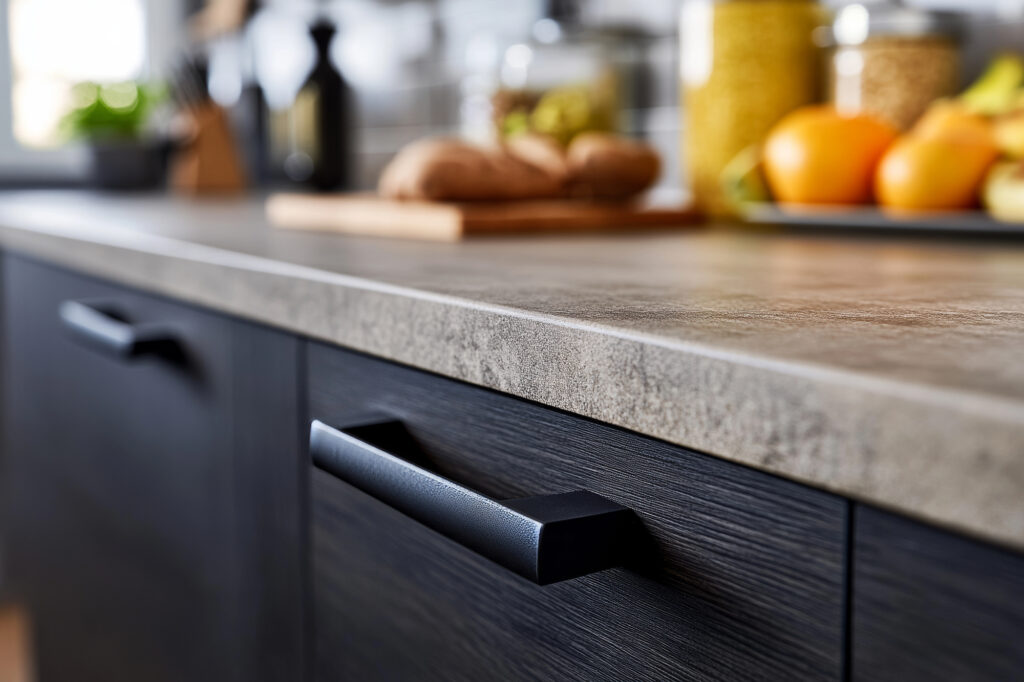
The Modern & Clean Profiles: Simplicity Rules
For kitchens leaning toward contemporary, transitional, or minimalist styles, the following edges provide clean lines and quiet sophistication:
- The Eased Edge: This is arguably the most popular and versatile edge today. It features a straight, 90-degree angle, but the sharp corners are slightly “eased” or rounded off.
- Why it works: It offers the visual simplicity of a square corner without the danger of a sharp point. It is easy to clean and universally complements any cabinet style, from shaker to flat-panel.
- The Beveled Edge: This profile involves a cut, usually at a 45-degree angle, along the top edge of the countertop.
- Why it works: It adds a subtle geometric detail that helps to reflect light. It’s a great way to add visual interest without being overly ornate. A half-bevel features the angle cut on the top only, while a full bevel has cuts on both the top and bottom.
- The Mitered Edge: This is a technique rather than a simple profile. It joins two pieces of stone (one for the top, one for the edge) at a perfect 45-degree angle to create the illusion of a much thicker slab.
- Why it works: It’s a premium, high-end look often used on thick islands or waterfall edges, providing a sleek, powerful, and seamless visual impact that emphasizes the material’s natural pattern.
The Classic & Soft Profiles: Timeless Warmth
These profiles are defined by curves and softness, making them perfect for traditional, classic, or family-friendly homes.
- The Half-Bullnose (or Demi-Bullnose): This profile is rounded on the top edge but flat and straight on the bottom.
- Why it works: The curved top is soft, safe, and easy to clean, making it a favorite for busy kitchens with children. The flat bottom minimizes the visual drag of spills, which tend to run straight down to the floor.
- The Full Bullnose: A completely rounded, semi-circular edge profile on both the top and bottom.
- Why it works: This is a truly classic, traditional look that emphasizes the softness and warmth of the material. It is exceptionally safe for children, but cleanup requires a little more attention, as spills can tend to wrap under the counter.
The Elegant & Decorative Profiles: Making a Statement
When your goal is to add drama, detail, and an ornate flourish, these profiles deliver a luxury, furniture-like feel.
- The Ogee Edge: This is a highly decorative profile featuring a graceful S-shaped curve (a concave curve flowing into a convex curve).
- Why it works: The ogee is the standard for high-end, traditional, and formal designs. It adds instant sophistication, making the countertop feel like a custom-built piece of furniture. It is often reserved for islands or vanity tops to create a focal point.
- The Chiseled Edge: A rugged, textured edge that looks intentionally left unfinished.
- Why it works: This edge emphasizes the raw, natural quality of granite or other stone, making it a perfect match for rustic, farmhouse, or Old World-style kitchens.
Find Your Edge Profile at National Design Mart Serving Northeast Ohio
The difference between an Eased edge and an Ogee edge can completely change your kitchen’s aesthetic. Whether you are aiming for clean modernity or elaborate elegance, the right edge is essential to perfecting your design.
Visit National Design Mart at our Medina and Wooster locations. Our design team will help you pair the perfect edge profile with your chosen stone and cabinet style to ensure your kitchen is flawless, right down to the last curve.